
Debbie Grattan Voiceover Branding Logo
  • HOME
  • DEMOS
  • ABOUT
    • BIO
    • RECENT PROJECTS
    • TESTIMONIALS
    • CLIENTS
    • WHY HIRE DEBBIE
    • STUDIO SPECS
    • RESOURCES
  • SERVICES
    • SERVICES
    • COMMERCIALS
      • COMMERCIALS
      • HEALTH & MEDICAL
      • AUTOMOTIVE
      • BUSINESS & CONSUMER
      • CHILDREN’S PRODUCTS
      • POLITICAL
      • INFOMERCIALS
      • RADIO SPOTS
    • NARRATION
      • NARRATION
      • CORPORATE VIDEOS
      • HEALTH & MEDICAL
      • TECHNICAL
      • E-LEARNING
      • WEB VIDEOS
      • EXPLAINER VIDEO
      • TRAVEL & LEISURE
    • INFOMERCIALS
      • INFOMERCIALS
      • CHILDREN’S TOY
      • BEAUTY AND COSMETIC
      • HEALTH, FITNESS & OTHER
    • CHARACTERS
      • CHARACTERS
      • ANIMATION VOICE OVER
      • ACCENTS & DIALECTS
      • ON-CAMERA ACTING
      • CHILD TEEN VOICEOVER
    • PHONE RELATED
  • BLOG
  • CONTACT
    • CONTACT DEBBIE
    • REQUEST A QUOTE
    • REQUEST AN AUDITION

VERSATILE

EXPERIENCED

PROFESSIONAL

1-866-DGVOPRO

For Voice Over Clients

A Client’s Guide to Selecting the Right Voice Over Talent

October 14, 2017 by Debbie Grattan

Selecting the Right Voice-Over Talent

As a voice seeker, whether you have a precise vision, general idea, or absolutely no clue about the type of voice you’re seeking for your next project, most voice over talent searches involve a multi-step, all-purpose process. Perhaps you’re new to the game and are not sure what to expect, in which case this guide will fill you in on how to select the right voice over talent. Or maybe you’ve already been through the selection process before, in which case this guide may contribute some helpful hints.

In either case, the best place to start (of course) is with Step 1.

voice-over talent availability is top priority

Step 1: Know the Ground Rules

Before you even begin your search, it’s important to keep a few basic tenants in mind. They’re not really rules per se, but rather useful tidbits of info that can help shape your search for the ideal voice over talent.

The ideal voice-over talent should be:

  • Available when you need them
  • Eager and willing to answer your questions
  • Geared toward making your job easier
  • Out for the same goal, you are: a truly brilliant project resulting from an equally brilliant collaboration

The ideal voice-over talent should NOT be:

  • Available every other weekend, but only when it rains
  • Unresponsive to emails and phone calls
  • Disgruntled when you ask for, well, anything
  • Out only for making a buck, slapping the job together as quickly as possible, or otherwise “getting it over with” so they can move on to something more fun.

searching for voice-over talent

Step 2: Start the Voice Over Talent Search

When you’re not sure how to start your voice-over talent search, nothing can be more intimidating than a blinking cursor on the computer screen that’s just waiting for input. Try inputting stuff like this:

  • World Voices Organization (WoVO): The voiceover.biz link on the organization’s site lets you search its database of union and non-union, vetted voice-over professionals ready for action.
  • Search terms related to voice-over professionals: Think of the type of voice you want, then enter terms that match. Start with the base terms such as: “Professional voice talent” or “Professional voice-over talent” then add details that match with what you’re looking for. Examples include:
    • Gender: male or female – Ex: “female voice over talent”
    • Project type: commercials, explainer videos, infomercials, narration, animation – Ex: “female voice-over talent for commercials“
    • Industry: health care, automotive, beauty, children’s toys, finance – Ex: “female voice-over talent for automotive commercials
    • Tone/style: sultry, high-energy, sophisticated, authoritative, conversational – Ex: “female voice-over talent high energy”
    • Special skills: British accent, characters, American dialects – Ex: “female voice over talent British accent”

You get the idea. Mix and match search terms to your heart’s content until you find a voice (or five) that draws your interest further. Then move on to Step 3.

voice over demo review

Step 3: Review the Demos

Since they can be re-recorded and edited to perfection, demos are not the end-all for choosing your ideal voice-over talent. But they can certainly be helpful to get a general idea of what a professional voice over talent sounds like.

Whether you’re reviewing an actor’s portfolio on a site like WoVO or looking at a voice-over pro’s own website, it shouldn’t be hard to find their voice over demos. Demos are typically part of the talent’s portfolio of work, providing a variety of projects, styles, and other examples that showcase the best of the best.

request a custom voice over audition

Step 4: Request a Custom Voice-Over Audition

Demos can give you a general idea of voice-over talent’s range and capabilities. Sometimes that can be enough to make your final decision. But if you want a more definite idea of how the actor would sound in your specific project, you can request a custom audition.

Most voice-over actors accept or even encourage custom auditions to give you a sample of what they can do for your script. Send the talent a paragraph or so from your script on a separate attached document. Include direction or not, depending on what you’re after. Sometimes not providing direction results in a nice surprise when a seasoned pro provides an alternate take that may not have entered your mind.

Review the auditions you receive, pick your winner, and then move on to the next step.

nail down the details for your voice-over project

Step 5: Nail Down Project Details

You may have several questions for your selected voice-over actor before the project can move forward…And the voice over actor is likely to have several for you.

Possible questions from the voice-over talent may include:

  • Where and how the recording will be used, i.e. major broadcast with a massive audience vs. a company YouTube channel with 122 subscribers
  • How long the recording will be in action, i.e. one week, one year, forever and ever
  • Length of the script, i.e. 30-second radio commercial, a two-hour documentary
  • Format needed for final recording, i.e. MP3, AIFF, .wav file
  • Delivery deadline, i.e. one hour, 24 hours, two days, one week
  • Interest in using a phone patch that lets you listen in and contribute to a recording session

Each voice-over actor has his or her own rate scale, with multiple factors going into determining price. If you’re curious about the rate scale, simply ask. The same holds true for anything else that may be on your mind. Personally, I use a rate scale as a template, but try my best to be flexible within each client’s specific budget.

Remember, a professional voice-over actor wants to make your job easier and engage in fruitful collaboration while being paid a reasonable and fair fee for their work. Trust should be enjoyed on both ends of the partnership. Find a voice-over actor that fits the bill on all of the above while providing a voice that makes your project shine, and you’ve found yourself a keeper.

Keep the person in your contact list for additional voice-over projects down the line, or even to ask then for other voice talent recommendations if you or others in your company need a different sounding or type of voice for upcoming projects. That way you can refrain from ever moving on to Step 6, which is to start the search process all over again.

Please contact me if you think I can be of service to you in finding just the right voice-over talent for your next project!

You may also find these articles useful:

“When You Need More Than Just a Voice-Over Actor”

“Key Factors to Consider When Hiring Voice-Over Talent”

“When Hiring Voice-Over Talent, Watch Out for Hidden Fees”

Filed Under: For Voice Over Clients Tagged With: how to hire better voice over talent, voice over talent

It’s Survival of the Fittest in Today’s Voice-Over Gig Economy

September 15, 2017 by Debbie Grattan

It's survival of the fittest in today's voice-over gig economy

While the gig economy is nothing new, it is going through a rather new transition. It’s being flooded by an influx of workers. Millions of fresh workers entered the world of flex and freelance work between 2003 and 2013 alone. From video production to copywriting services, fitness training to photography, fields across every industry are feeling the effects. The voice-over realm is one of them.

This increase in workers leads to an increase in competition. And one of the strategies some workers use to beat out the competition is to offer impossibly low prices. While this may initially appear to clients as a great move for a business, it’s actually not. Not for the client’s business or the voice-over actor’s business.

Why Impossibly Low Prices are Never Good for Business 

Since the lowest prices are typically offered by new workers with the least amount of experience and industry knowledge, the low cost of the work is likely to be reflected in the quality. On the voice-over talent’s end of things, offering impossibly low prices not only makes it tough to make a living, but can also reflect negatively on their professional reputation. Only those who are not confident about what their work is actually worth would even dare to set a price that’s ridiculously below the skill, talent, and scope of a specific project.


voice over gig economy pits fittest voice over talent against not-so-fit talent

What Eventually Happens

Prices can’t continue their downward spiral forever. There’s got to be a breaking point. That breaking point tends to come when the workers start to thin themselves out, in a process that’s reminiscent of natural selection – where only the fittest survive. Those that are not-so-fit for the industry may bow out for any number of reasons, some of which are outlined on voice-over actor Paul Strikwerda’s Nethervoice blog:

  • Not booking enough jobs or any jobs
  • The goal of instant stardom
  • Can’t afford to invest in quality equipment or coaching
  • Hard time getting motivated
  • Fed up with the same old tasks, over and over
  • Not sure how to market self
  • Crushed by repeated rejections
  • Stressed out by freelance uncertainty
  • Working too much for too little
  • Don’t know how to stand out from the crowd

“If even pros with years of experience and an impressive portfolio have trouble booking jobs these days,” Strikwerda writes, “you need to bring something very special to the table if you wish to compete at the highest level.”

The Fittest Who Survive

Voice-over actors who can indeed compete at the highest level, who bring something special to the table, and who have paid their dues over the years are those who are likely to survive. Members of the fittest group typically:

1. Are backed by years of experience and training

2. Have full-time availability and are easily accessible when needed

3. Record on sophisticated equipment in a professional studio

4. Focus on high-quality results

5. Have found their niche

6. Are constantly learning new things, developing new skills

7. Know their worth, and charge prices that reflect that

8. Are strong, determined, and persistent enough to stick with their voice-over career/dream no matter what

No matter what’s going on with the gig economy in general or the voice-over industry in particular, the thought of quitting is not likely to cross their minds.

While the sharp plunge in price and quality may be bad news in the overall gig economy, the good news is the fittest exist in every industry. Clients can find them and hire them at any time. Evidence in the voice-over industry includes a strong portfolio, sophisticated recording equipment, versatility, skill, extensive experience, high-quality work, and a long history of happy clients.

Ready for your next high-quality voice-over project? Contact me for a quote or complimentary audition today.

Related Articles You Might Like:

  • When You Need More than Just a Voice-Over Actor
  • Getting the Right Voice-Over Read for the Right Project
  • Can You Spot the 14 Voice-Over Mistakes Waiting to Happen?

Filed Under: For Voice Over Clients, For Voice Over Talent Tagged With: voice over economy, voice over price

Voice Over and Virtual Reality Marketing Fit Like Hand in Glove

August 15, 2017 by Debbie Grattan

Manus VR Gloves and the HTC Vive for Exceptional Virtual Reality ExperiencesVirtual reality has become a literal reality, one of the hottest new developments in today’s technology. You can find it being used in everything from VR games to instructional how-tos to VR apps to virtual reality story-telling behind one of the best-selling organic soap brands in the world. I mention the soap since Dr. Bronner’s was the first voice over and virtual reality video project I had the thrill of completing. And yes, it was certainly a thrill.

The 6-minute virtual reality video provides information, entertainment, a brief company history – and the chance for viewers to enjoy a full 360-degree view in all directions throughout the entire video.

You’re treated to outdoor festivities (complete with a line of costumed dancers), aisles of soap products, videos playing in the background of the video you’re watching, and, perhaps most importantly, a grand tour of Dr. Bronner’s headquarters in Vista, California.

Promoting soap companies is just one of the many ways virtual reality can and is already being used for the benefit of companies, their audiences – and VO talent hired to be an integral part of the VR projects.

Virtual Reality for Marketing

With a well-crafted script that tells a compelling story, VR marketing campaigns can be hugely compelling for any brand. Dr. Bronner’s and other companies have already figured that out, with another fun example coming from the cheese company Boursin. While Dr. Bronner’s gives you a  360-degree view of headquarters and festivities, the Boursin VR video gives you a 360-view of the inside of a fridge where Boursin cheese hangs out with other delectable goodies.

The top benefits of VR videos for marketing include the following:

  • Truly engaging your audience in ways that are cutting-edge and very stimulating
  • Capturing the viewers’ full focus and attention, devoid of outside distractions
  • Providing a more intense experience than traditional media, making it (and the brand) more memorable
  • Capitalizing on virtual reality’s novelty for companies quickly out of the VR starting gate

Virtual Reality for Documentaries and News

Dr. Bronner’s told the company story using VR video, and storytelling of any type can get a huge boost with virtual reality technology. A solid example is the New York Times, with a VR documentary entitled “Displaced.” The VR video tells the story of 30 million children driven from their homes due to the ravages of war, letting viewers do more than just read about what it’s like. Viewing the NYT video requires downloading the NYTVR app, which you can do here.

Virtual reality video for news stories and documentaries has the power to:

  • Put viewers at the very heart of the story
  • Stir up stronger emotions due to a more memorable and intense experience than traditional media
  • Provide the full impact of surroundings with total 360-degree views

VR for Training and Testing

Training videos offer another way to use virtual reality technology for awesome results. VR training videos can go far beyond car mechanics and electrical wiring projects. They can provide driving or flight training without the hazard of putting novices behind the controls. They can also help doctors learn complicated surgical procedures without risk to patients.

Mercedes created an app that lets you test-drive its E-Class. While it’s technically a marketing video, it does give you an idea of what a VR driving video could look like. Below is the VR test drive video, and be sure to grab the screen to change the view as you go along.

Benefits of VR for training and education include:

  • Giving audience members a chance to attempt complex tasks as many times as they wish
  • Eliminating the real-life risks associated with real-life training of the tasks
  • Ensuring trainees have a safe environment at all times
  • Saving money by producing a single VR video instead of multiple real-life training scenarios

Virtual Reality for Gaming and Entertainment

My family knows the excitement of virtual reality gaming firsthand, thanks to our daughter Natalie, who invested about $2,000 of her VO gig money into an HTC Vive VR System last summer. We’ve all been playing VR now for over a year. This Vive VR demo video captures the experience of the Vive pretty well. It is truly a mind-blowing experience to interact with some of these virtual environments. And we are at just the beginning of content creation. It will just keep getting better and better as time goes by.

For an in-depth review of some of the most popular VR headsets, check out Top Virtual Reality Headsets and Their Breakdowns

VR gaming gives you the chance to:

  • Experience an actual alternate world, transforming the act of watching a screen into living an actual experience
  • Escape from the daily grind
  • Engage in high-powered, realistic amusement

Pretty cool, huh?

Other Voice Over and Virtual Reality Marketing Opportunities

While I touched on some ways VR is already being used, the above categories definitely don’t cover all of them. Virtual reality videos and technology are also being used for a variety of other applications, such as helping:

  • Travelers pick vacation destinations by letting them “visit” possible locations before they choose.
  • People cope with post-traumatic stress disorder and phobias, using varying levels of exposure therapy until they’re able to deal with feared objects, places, or circumstances.
  • Patients undergo physical rehabilitation and learning tasks in a clinical setting before applying them out in the real world.
  • Patients cope with pain by using distraction therapy while undergoing painful procedures.
  • People manage anxiety and reduce anxiety attacks, with a VR game that comes with a wearable belt that teaches and encourages diaphragmatic breathing.

As extensive and amazing as these examples maybe, they’re only the starting point of what virtual reality is poised to achieve. Keep in mind, however, that the high-end technology of VR alone isn’t necessarily enough to attract and then keep the attention of your audience. You also need a quality script, a solid story, and, in many cases, the addition of a voice over actor who can add another layer of intrigue to an already intriguing project.

Filed Under: For Voice Over Clients Tagged With: Featured, virtual reality, vr voiceover

Getting the Right Voice Over Read for the Right Project

June 15, 2017 by Debbie Grattan

Getting the right voice over read can depend on several factors including audience, setting and topic

You want a totally different mood and sound for a voice-over spot that’s selling cars than for a voice-over video explaining a complicated medical procedure. So how do we VO artists know what voice over read to deliver? Well, sometimes we don’t.

Some scripts present a myriad of options, all of which could work. Getting the “right” read depends largely on what a client believes is “right.” Sometimes clients have input on what they’re envisioning for the final result. But sometimes the clients themselves aren’t exactly sure.

When it’s not totally clear from the get-go what type of voice over read is going to be the “right” one for a client, I have several strategies on hand to ensure the final product delivers exactly that.

Considering Various Elements

When a script or client doesn’t offer direction on tone or style, it’s time for the acting abilities to kick in. My first inclination is to review the script to determine how I would be relaying the information to a close friend. Would I be engaged in a quiet, intimate discussion, or excited and enthused? That answer often comes from reviewing three key areas.

  • The audience:

    Determining exactly who I’m talking to is incredibly helpful for determining the voice over read. Here I assess the gender, age, interests, profession, and other details that flesh out the script’s intended audience. A read that’s highly effective for a 12-year-old girl may bomb miserably for a 72-year-old man, for example.

  • The setting:

    A lot depends on where the script’s scenario is taking place. Talking to a close friend in her kitchen is going to have a different feel than talking to her at the county fair. You’ll also find different reads at work in an office, at work in a factory, at play in the park, or hanging out at the bus stop.

  • The topic:

    The read is definitely going to be steered by the topic being discussed. The compassionate, calming tone used for sensitive topics, such as medical procedures or health-related issues, is a far cry from the excited, enthusiastic read exclaiming the latest kitchen gadget is the coolest thing in the world.

Putting all these details together gives me what I need to “act the copy,” or tune in to my acting abilities to read the script as a character in the scene. The strategy is highly effective as well as consistently successful.

Working with clients in a live session can be the easiest way to nail the voice over read exactly how they want it.

Working with Clients in Real-Time

Working directly with the client during the recording session is another surefire way to get the right voice over read, and the phone patch makes that possible even when we’re miles away. In fact, I had a successful phone patch session last week where both a new client and advertising agency were on the phone with me during the session.

They had provided a concept around their branding, with descriptive words like bliss, peace and authenticity, and a very particular sound that would speak to an audience of millennials.

In cases like this, it’s useful to set up a benchmark read in a session, providing an initial read while keeping all the details in mind – and then adjusting the read accordingly, based on additional input from the client.

Specific changes are typically very easy to pinpoint and make when using the initial read as a starting point. Changes can include things like taking some inflection out, putting some pauses in, warming it up with more of a smile, and all the other little nuances a professional voice-over artist can bring to a session.

When clients can listen in on a recording in real-time, they can just as rapidly add useful input to achieve their desired results. Gotta love the phone patch.

Providing several voice over read options will also make the producer's job easier

Providing Different Voice Over Read Options

Even with a solid scenario and clear direction, there may be room for different variations of a single script.

One place this happens is with audition situations, although some may not provide much direction at all. In audition situations, I may actually give two full takes (or more, if the copy is short) of the audition script. Not only does this let the client review different interpretations of the script, but it also showcases my full range of abilities. And that’s a pretty handy aspect to showcase to someone who is considering hiring you.

Another situation in which I may give more than one voice over read is with relatively short sessions where I’m itching to share a slightly different read than the one I delivered. Here I’ll definitely give clients what they asked for, but I may also go ahead and read the script in a way that I personally feel would work best.

Sometimes the clients are happily surprised and go with the different take. Other times they simply thank me and stick with their original.

It’s all a matter of taste. Kind of like drinking a glass of wine. If two different people were to drink a glass of the same wine, you’d get two different reactions to it. The “right” read remains very subjective, and my overall goal remains to deliver a read that’s always right for the client’s needs.

Looking for the “right” read on your script? Contact me for a custom audition and we can work together to make it happen!

For more information on similar topics, please check out these related blog posts:

“A Client’s Guide to Selecting the Right Voice-Over Talent”

“Before You Hire Voice-Over Talent, Run Through This 10 Point List”

“6 Reasons People Trust a Female Voice Over Male Voices”

Filed Under: For Voice Over Clients Tagged With: voice over mood, voice over read

My New Voice-Over Recording System is a Gorgeous Change

May 15, 2017 by Debbie Grattan

My New Voice-Over Recording System is a Gorgeous ChangeWe’ve all heard the saying that change is the only constant in life. When I upgraded my voice over recording system I ran across another quote that sums up my recent encounter with change even more accurately. Writer and motivational speaker Robin Sharma says:

Change is hard at first,
Messy in the middle
And gorgeous at the end.

The recent change I had to make involved switching my recording software from Sony Sound Forge to Adobe Audition and upgrading my entire voice-over studio setup, which I’ve known and used the same way for over fifteen years. The transition definitely followed the path of being hard, messy, and then ultimately about as gorgeous as you can get.

The Hard Part

It’s always tough to give up something you know and use every day – and that certainly held true with my trusty voice-over recording system. But, since Sony sold their interest to a German company, Magix, and support was no longer available (no return of my phone calls or emails despite repeated attempts), I basically had two choices:

  • Stick with the system I had known for as long as I’d had a home studio, despite the glaring lack of service or stability under the new ownership,
  • Jump ship and go with something totally new and different.

The second choice seemed the painfully obvious “right” one to make. It was time to say goodbye to the old and welcome something new.

Change can be messy sometimes

The Messy Part

Thankfully, doing the research for a new system wasn’t all that messy. That’s because we tapped into the knowledge of a long-time professional voice-over actor, Todd Schick, who mentored us along the way to a degree that was beyond my wildest expectations. Calling on colleagues is always an ideal way to gain insight and knowledge on a variety of topics, particularly when it comes to exploring relatively unfamiliar territory – like technology. Todd knows pretty much everything about everything when it comes to home studios. And, what he doesn’t know he can figure out very quickly.

Technology, in general, is pretty messy in my opinion, so the installation and setup of the new system went to two guys who knew what they were doing: Todd and my husband, Paul, who wears many hats including a resident IT person. There was a fair amount of new equipment to buy and problems to work through. All told, it took a full month to get the studio space assembled with all of the new pieces installed and working properly. During that time, I focused on learning how to work with the new Adobe software.

Learning the new system started out a bit rough, but then quickly turned amazing when I realized the full extent of what the new voice-over recording software could do. Keyboard shortcuts are now my friends, and I’m now speeding along at a much faster clip with my editing and workflow.

The Gorgeous Part

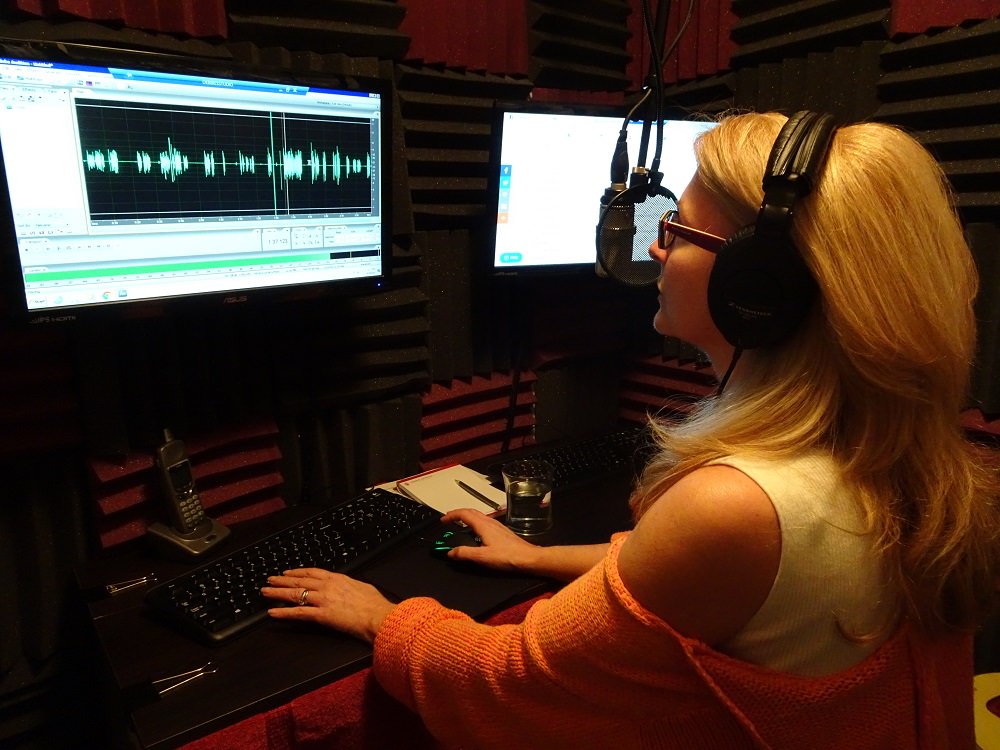
gorgeous new voice over recording booth, with double monitors and massive upgrade in efficiency
Here’s my gorgeous new voice over recording booth: Double the monitors, double the fun!

Although I thought my workflow was streamlined and efficient with my old system, I honestly didn’t know what I was missing. The true beauty of the upgraded system was at its optimum performance when, shortly after getting everything up and running, I had a recording session that involved all three of these elements simultaneously:

  • One video editor client in the Netherlands calling in on Skype
  • The end client and ad agency folks in multiple offices in Seattle conferenced on my ISDN/Phone Patch
  • A video playback, to review the scratch track that my VO would soon replace

Perhaps the best way to illustrate the beauty of the new is to showcase a before and after.

BEFORE the New System Upgrade

The only way to connect with multiple clients remotely was for me (using my ISDN/phone patch Suprima LC) and everyone else to call into a conference bridge, which serves as a virtual conference room for callers. While this worked OK with clients throughout the U.S., it wasn’t as friendly for clients overseas. And, it wasn’t configured for Skype.

My system was also pretty finicky connecting with a variety of different platforms, often using a cell phone to connect over Skype with earbuds under my headphones, and not being able to connect with other clients with my ISDN box.

When it came to assessing the voice-over needed for a video, I had to do a lot of pre-session work analyzing the video. I’d typically have to go through and mark the timing of different segments, note every minute detail, and then create the voice-over track to align with the video based on my notes, without access to the video during my session.

And I also lacked access to my recording software in real-time in my booth.  I would basically just hit “record” in my office, and go into my booth and record the entire session, with no control… leaving me with a sometimes very long audio file at the end to edit down to send to the client.

AFTER the New System Upgrade

Cue the harp…angels singing…The new system gives me two different computers, each connected to two monitors in my recording booth, which are also doubled in my studio office in a separate room. On one, I can access Adobe Audition, using my keyboard and mouse to control my recording session in real-time.

Forget about pre-session video analysis. On the other monitor, I have access to EVERYTHING else during the session, such as emails, computer files, scratch videos the client has sent me via DropBox or Hightail, YouTube videos (for pronunciation of tricky words, assisting with accents, character prototypes, etc.)  and – you guessed it – Skype.

Using my new system, this particular session involved the client from the Netherlands calling in via Skype, the team of people in Seattle calling into a conference bridge, which I was able to access using my ISDN box, and all of us communicating freely throughout the session. I was able to play the video, hearing the scratch read in my headphones, while I recorded myself re-doing the voice over to match it.

The end result was efficient, effective – and actually quite fun. If that’s not the epitome of a gorgeous voice over recording session, then I don’t know what is!

The Biggest Benefit For Voice Over Clients

I could go on and on about the details and intricacies of my new setup. But, all that really matters is I am a lot faster and way more efficient than ever before. My workflow process has been streamlined to an exponential degree. And, while I always have strived to be very fast and efficient with what I do, the mental cost on me was much higher than I realized, given the inefficiencies of my previous workflow. So now, I can knock out super fast turnarounds without feeling much stress.

It really is one of the “night and day” kinds of difference for me.

So, the next time you’re digging in your heels against change, don’t forget how fabulous it can actually turn out. Change may not always come when and how we want it, but it can bring plenty of benefits just the same.

Want to check out what my new voice-over system can do for you? Contact me for a custom audition or voice-over quote today.

For more posts on similar topics, please check out:

“Before You Hire Voice-Over Talent, Run Through This 10 Point List”

“Key Factors to Consider When Hiring Voice-Over Talent”

“Top 10 Reasons to Hire Debbie for Your Next Project”

Filed Under: For Voice Over Clients Tagged With: voice over recording, voice over system

Can You Spot the 14 Voice-Over Mistakes Waiting to Happen?

April 15, 2017 by Debbie Grattan

Can you spot the 14 voice-over mistakes waiting to happen?

Your script is written and ready to go. It’s short, straightforward, and simple. It doesn’t contain anything about complicated medical procedures, highly technical computer jargon, or words that have been translated from a different language. You’ve hired a professional voice-over talent to record it, and have about one hour to deliver the finished recording to your boss. No problem, right? Not so fast. There could be plenty of voice over mistakes brewing in even the simplest-looking scripts if the copy is not carefully reviewed to ensure the voice-over actor knows exactly what you want. And we’re not just talking about directions on tone, emphasis, and style. We’re talking about a host of issues within standard copy that could turn a quick VO project into a long and arduous ordeal.

To illustrate the point, I created a seemingly simple script of exactly four sentences – that’s actually not so simple at all. The script is packed with 14 potential mistakes just waiting to happen if the voice-over talent isn’t given a heads up on specific preferences the client desires.

Review This Sample VO Script – Do You See Any Problems Brewing?

Well, folks, we will be having our annual party to celebrate yet another successful completion of our animal/plant life data project! Invites will go out ASAP, and this year’s topic is the effects of caramel on animal/plant life. Neither appeared to mind the gooey substance. Researcher Sinead Linux looked at data from 1996 to 2016 and found a total of 592 different benefits caramel brings to plants/animals (i.e. it prompts growth).

Avoid These Potential Voice Over Mistakes

Voiceover Script Mistakes Create Confusion for the Voice Talent

Mistake No. 1 – “We will”

While the copy uses “we will,” the copy also kicks off with a very casual opening. An experienced voice-over artist may be inclined to keep the casual vibe alive by changing “we will” to “we’ll” for a smoother, more conversational flow.

Avoid the issue: Use contractions if you want a friendlier, more casual copy. Don’t use contractions if you want a more formal tone. Make sure your choice, however, is consistent with the rest of the copy’s tone.

Mistake No. 2 – “Animal/plant life”

Voice-over artists have numerous ways to interpret slashes, and chances are high they’re not going to pick the exact way you want it unless you prep them in advance. This particular slashed phrase could be read as:

  • Animal and plant life
  • Animal or plant life
  • Animal and or plant life
  • Animal (pause) plant life

Avoid the issue: Skip slashes in VO copy, spelling out what you want said instead.

Mistake No. 3 – “Data”

Do you want data pronounced “DAY-tuh” or “DA-tuh?” The VO actor has a 50/50 chance of getting it right. (Make that fifty fifty! See mistake number 2)

Avoid the issue: Words that have multiple pronunciation options should include the preferred pronunciation within the copy.

Help voice over talents with exact pronunciation

Mistake No. 4 – “Use of bold or ALL CAPS”

You put the invitation information in bold as a reminder to yourself to put it on your to-do list. But the voice-over artist read the information with massive emphasis. That’s not what you wanted!

Avoid the issue: Only bold copy or use ALL CAPS if you want voice-over talent to put a big emphasis on the bolded words or phrases.

Mistake No. 5 – “ASAP”

You wanted the VO actor to say “as soon as possible,” but he said “AY-SAP” instead.

Avoid the issue: Indicate within the copy how all acronyms should be pronounced.

Mistake No. 6- “Caramel”

Who says “car-mel,” making the word two syllables? Your VO artist, that’s who – even though you wanted the three syllable pronunciation of “car-a-mel.”

Avoid the issue: Indicate your preferred pronunciation of words that may have regional or alternate pronunciations across the country.

Mistake No. 7 – “Neither”

“NEE-ther” or “NIGH-ther?” Go back four steps to Mistake No. 3. Also, check out the Cambridge Dictionary and listen to British English and American English recordings of how words should be pronounced.

Clear enunciation directions for voiceover talent saves time and money

Mistake No. 8 and 9 – “Sinead Linux”

Names can be incredibly tricky to pronounce, especially those that are less common than the straightforward John Doe.

Avoid the issue: Include the pronunciation of any name that’s not as straightforward as John Doe. In this case, your copy could have read: “Sinead (Shin ADE) Linux (LEE necks).”

Mistake No. 10 – “1995 to 2016”

Nineteen-ninety-five is pretty straightforward. Unless, of course, you wanted it pronounced nineteen hundred ninety-five. Or nineteen hundred and ninety-five. The year 2016 also has a handful of variants:

  • Twenty-sixteen
  • Two-oh-sixteen
  • Two thousand sixteen
  • Two thousand and sixteen

Avoid the issue: Spell out in letters how you want numbers pronounced.  This is especially preferred with phone numbers in commercial copy. If you want 2414 to be pronounced twenty four fourteen, write it that way, or as 24-14.

Mistake No. 11 – “592”

Like 2016, the number 592 has at least two possible variations. Five hundred ninety-two vs. five hundred and ninety-two.

Avoid the issue: Same fix as mistake No. 10. Spell out in letters how you want numbers pronounced.  And if there is a decimal point used with your number (i.e. module 12.1 or civil code 345.91) – let your reader know if you need them to say “dot,” or “point,” or something else.

Mistake No. 12 – “Plants/animals”

This one can make for a triple whammy. Not only does it contain the bothersome slash, but it reverses the order of plants and animals from how the words have appeared previously in the text. It also changes the previously used “plant life” to plain ole “plants.”

Good VO actors may notice these inconsistencies and switch it back, putting animals first and changing plants to “plant life.” Or they may not, thinking you may have wanted the words reversed and changed for some reason.

Avoid the issue: You already know to avoid slashes. Do the same with inconsistencies with a thorough proofread of your text.  Don’t assume the VO talent reading your copy will understand what you mean, just because of it’s familiar usage to you.

smart script writing avoids voiceover talent errors

Mistake No. 13 – “i.e.”

How should the VO talent pronounce this? Choices include:

  • Phonetically, as in “eye-eee”
  • In Latin, as in “id est” (pretty unusual, but you never know)
  • The English translation of the Latin, which is “that is to say”
  • The English translation of the Latin e.g., which is “for example” – which is also really what you meant

The Latin abbreviations i.e. and e.g. have two different meanings yet are commonly confused for one another. The former provides more information while the latter provides an example.

Avoid the issue: Clear out the confusion altogether by spelling out what you want said in the copy, omitting abbreviations whenever possible.

Mistake No. 14 – “Use of parentheses”

Parentheses are nearly as annoying as slashes. Do you want the information contained within them read aloud? Or are they just there for additional information?

Avoid the issue: Only use parenthesis in VO copy to indicate a direction, pronunciation or other information that’s not intended to be said aloud.

As you can clearly see, even a short script can turn into a lengthy project with tons of edits, revisions, and do-overs. Avoid the headache by reading all your scripts aloud, with the mindset of a VO artist who is seeing it for the very first time. Clear up anything that raises a question, and you’re likely to clear up the potential for mistakes.

Avoid Costly and Tedious Voice Over Mistakes and Do-Overs

Another way to avoid costly and tedious mistakes is to hire a voice-over pro who knows just the right questions to ask before the recording even begins. With more than 20 years in the industry, I am happy to answer questions or provide a quote for your upcoming project.

For more posts on similar topics, please check out:

“When You Need More Than Just a Voice-Over Actor”

“Voice-Over Narration: Do it Yourself or Pay for a Pro?”

“8 Tips for Directing Voice Over Talent – What You Can Do BEFORE the Session”

Filed Under: For Voice Over Clients Tagged With: voice over career, voice over mistakes

  • « Go to Previous Page
  • Page 1
  • Interim pages omitted …
  • Page 14
  • Page 15
  • Page 16
  • Page 17
  • Page 18
  • Interim pages omitted …
  • Page 24
  • Go to Next Page »

Primary Sidebar

"*" indicates required fields

This field is for validation purposes and should be left unchanged.

Bring Debbie the details of your next commercial, narration, phone system recording or other voiceover project. Receive a detailed quote, custom audition, and the ultimate in voice quality.

CONTACT ME

REQUEST A DETAILED QUOTE
REQUEST AN AUDITION

CATEGORIES

  • For Voice Over Clients (144)
  • For Voice Over Talent (129)
  • Fun Stuff (10)
  • Uncategorized (2)

Search for:

Recent Posts

  • The Ultimate Guide to Remote Voiceover Direction: Tools, Best Practices, and Studio Standards
  • The Role of the Professional Voice Actor in an AI-Generated Media Landscape
  • Here’s the Coolest Pickleball Commercial That I Missed Out On
  • Keep the Awards Coming! VO Projects Win Big in 2025
  • Republican Negative Political Narration

Recent Blog Posts

  • Here’s the Coolest Pickleball Commercial That I Missed Out On
  • Keep the Awards Coming! VO Projects Win Big in 2025
  • The Impact of Rock Radio Imaging
  • The Ultimate Guide to Remote Voiceover Direction: Tools, Best Practices, and Studio Standards
  • The Role of the Professional Voice Actor in an AI-Generated Media Landscape
  • Here’s the Coolest Pickleball Commercial That I Missed Out On

1-866-DGVOPRO

Debbie Grattan is a top-rated professional female voice over talent with more than 25 years of experience delivering voice over services worldwide. She regularly records commercial voice overs for radio and tv as well as infomercial voice overs and direct response marketing for children's toys, health, fitness and beauty products. Other specialties include female narration voice overs for corporate narration, web videos, tutorials, explainer videos and technical medical narration. Debbie also provides phone-related voice over services including phone prompts, messages-on-hold and outbound phone marketing for companies in the United States and Canada.

Debbie Grattan Voiceover Talent source-connect
Debbie Grattan Voiceover Talent WoVO

© 2001 - 2026 Debbie Grattan Voiceover Talent | Site Map | Privacy Policy
Website Hosting by UpperLevel Hosting

  • HOME
  • DEMOS
  • ABOUT
  • SERVICES
  • BLOG
  • CONTACT